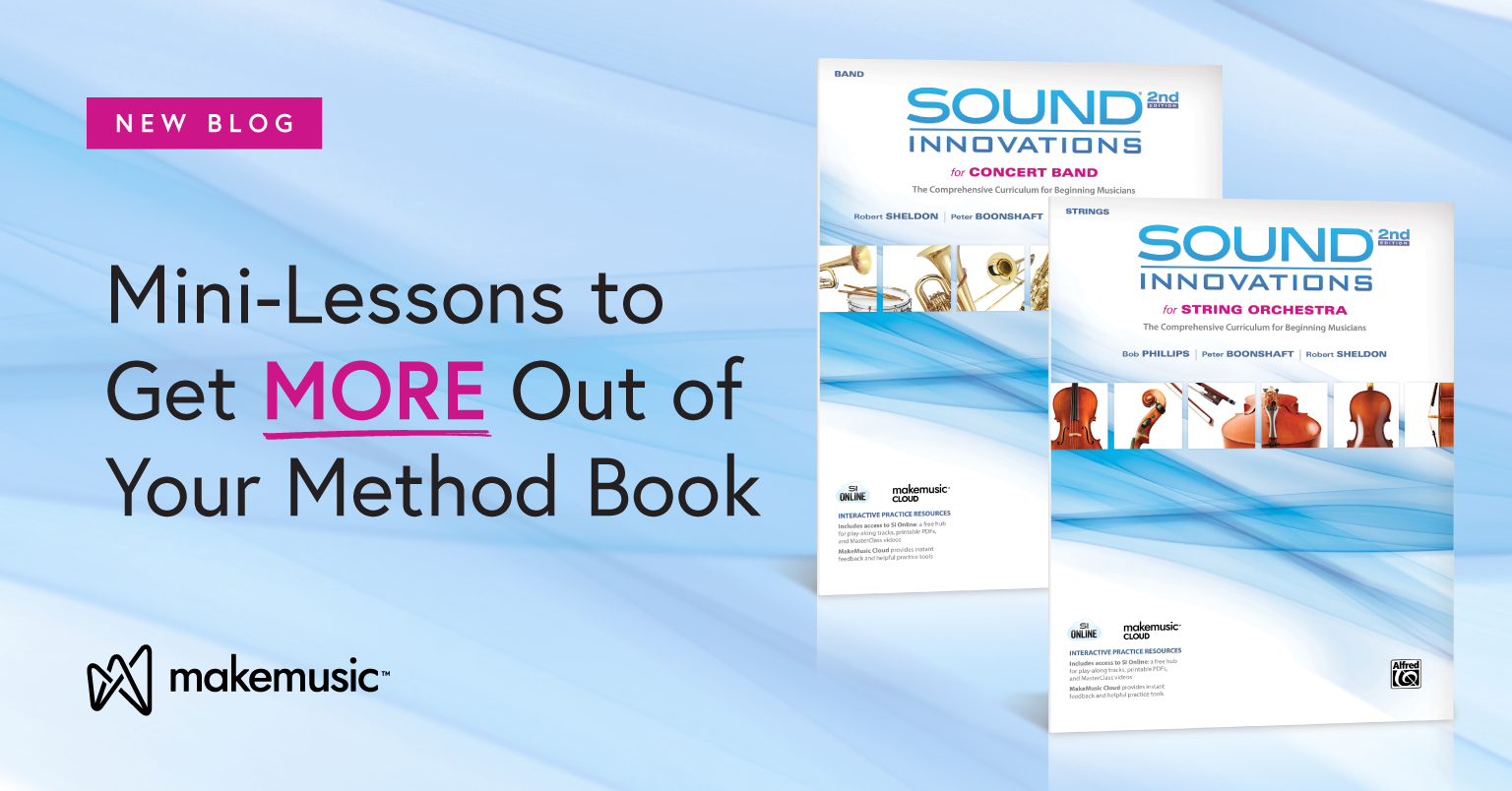
Most teachers have a handful of go-to exercises they rely on every day. Still, it can be helpful to have a new idea for getting a little more out of the lines you already teach. That is what these mini-lessons are meant to offer. Each one takes a familiar exercise from the Sound Innovations (SI) series and shows a simple way to use it in class right away.
You do not need to use SI as your primary method book for these to make sense. They are short, flexible ideas that fit easily alongside whatever you already do in rehearsal.
Before we jump into the lessons, here is a quick look at what Sound Innovations is and how it connects to MakeMusic Cloud.
What Is Sound Innovations?
Sound Innovations is a band and orchestra curriculum series of books that combines solid pedagogy, clear layouts, and a logical progression that supports students from their first notes onward.
Book 1 for band and strings is available for free in MakeMusic Cloud, making it easy to test lines, mix exercises into your routine, or use it alongside your current method.
Mini-Lesson #1: Listening to Characteristic Tone
Exercise: Passing the Tonic
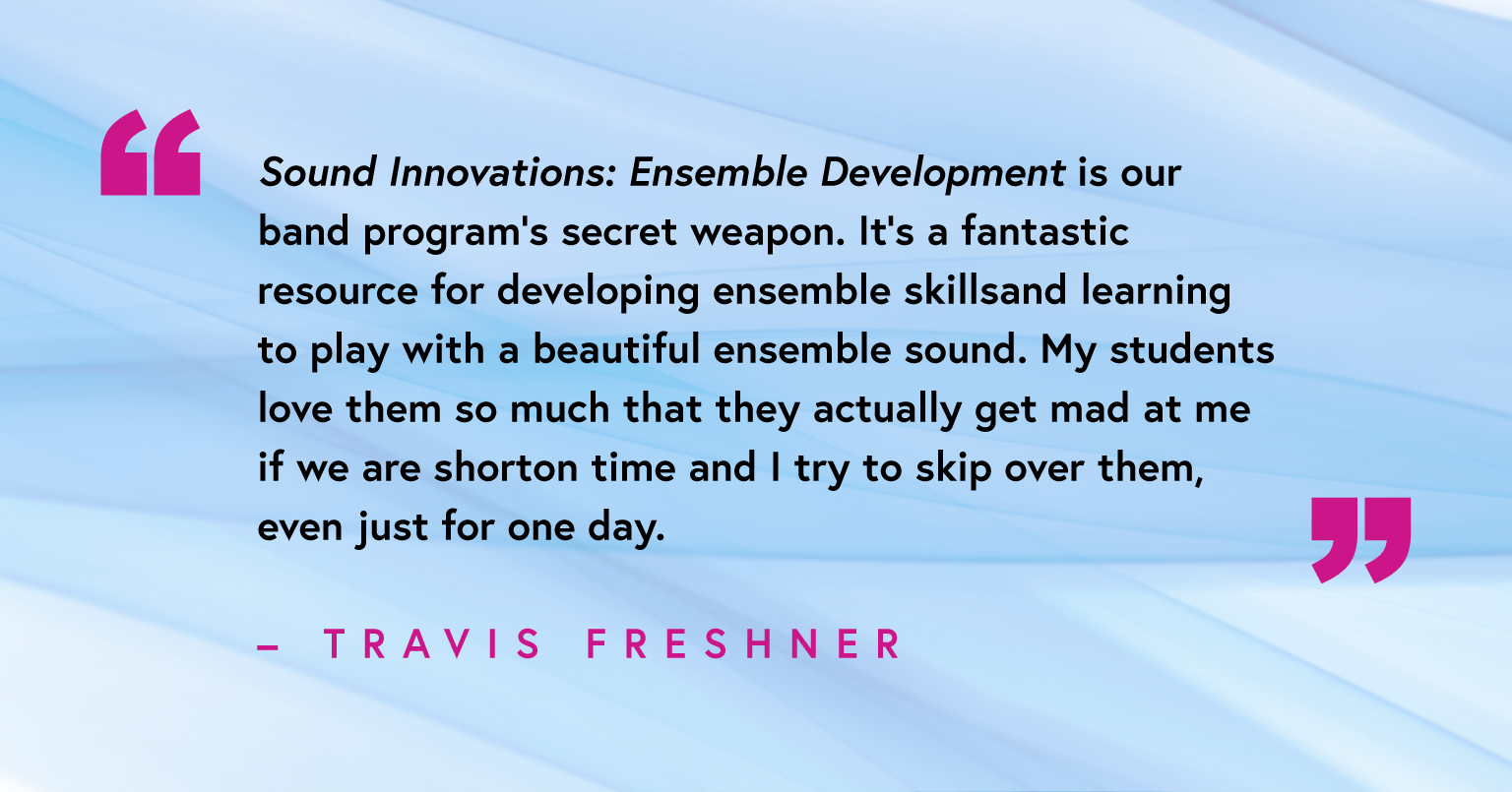
Book: Any Sound Innovations for Ensemble Development Book (SIED)
Goal: Listening for characteristic tone
“Passing the Tonic” uses the tonic note of a key and hands it off to different sections of the band. Direct your students to focus their listening on other instruments and to be prepared to describe what they hear in terms of the quality of the tone they are producing.
Ask them to go beyond basic descriptions like, “the trumpets sound bad” or “the bassoons are ridiculously loud.” Gross. Tell students to explore the ‘why’ part of their answer and provide that along with their analysis. For example, “The trumpets have a nice sound; they aren’t playing too loudly or too softly.” This is a first step in teaching students to listen critically, make decisions, and make a beautiful sound around the room.
Written by: Chris Bernotas
Mini-Lesson #2: Balance at All Dynamic Levels
Exercise: Expanding Intervals
Book: Any Sound Innovations for Ensemble Development Book (SIED)
Goal: Balance at all dynamic levels
The expanded interval exercises use various patterns of upward and downward intervals in unison, perfect intervals, and triads. As students grow stronger at performing these exercises and stay balanced as an ensemble throughout a given exercise, direct your students to perform them at different dynamic levels. The starting point is typically at mezzo forte. Ask students to then perform the exercise at piano and forte.
Following the exercise, ask students to evaluate their performance and experience with questions like “Did the ensemble stay blended at this dynamic level?” and “What happens to our airflow at different dynamic levels?” Be sure to incorporate percussion students into the discussion, as they need to balance just as much as the woodwinds and brass.
Encourage students that this is a skill that needs to be applied to the performance repertoire, as staying in balance at different dynamics is key to a stellar performance. As the students’ abilities grow, add more dynamic levels and incorporate crescendos and decrescendos in varying patterns.
Finally, explore this practice across the wide variety of expanding interval exercises in the book.
Written by: Daniel Pasquale
Mini-Lesson #3: Internal Rhythmic Accountability (“Bop It!”)
Exercise: The Banana Boat Song (or any line with long notes/ties)
Book: Sound Innovations for Concert Band, Book 1
Goal: Count through long notes and ties accurately
Nothing clarifies a long-note passage like a fun session of “Bop It!” Your students will have a love/hate relationship with this exercise—it will make them sound better, but it will also show them when they are incorrect.
To “Bop It,” simply have students play the first eighth note of each note longer than a quarter note, leaving no sustained pitches and forcing them to really think through long notes. Compare it to clapping a rhythm and demonstrate on your own instrument, or sing if at all possible. Especially helpful with ties and very long notes, establishing this technique on a simpler exercise will allow you to pull it out of your toolkit when a more advanced situation arises!
Once they can successfully “Bop It” together, have them play through at “full value” and enjoy the sparkling rhythm. Bonus: Use “Bop It” to remind students of staccato note length as you get to it!
Written by: Marianne White
Mini-Lesson #4: Dotted Quarter Reinforcement (Subdivide Eighth Notes)
Exercise: All Through the Night (or any dotted-quarter line)
Book: Sound Innovations for Concert Band, Book 1
Goal: Build confidence performing dotted quarter note rhythms
Review dotted quarter note value in a way that you would typically explain it to your students, better yet, have THEM explain it to you.
Guide students to discover (or remember) that dotted quarter notes are made up of three eighth notes. Instead of playing the line as written, have students articulate 3 eighth notes each time they get to a dotted quarter note.
Next, divide students into A and B parts: have the A’s subdivide while the B’s play “as written,” then switch it up before all playing tutti “as written.”
Written by: Marianne White
Mini-Lesson #5: I Play, You Play
Exercise: Three-Four, Phrase Some More, or any line that you want to demonstrate style, dynamics, or phrasing (or anything else!)
Book: Sound Innovations for Concert Band, Book 1
Goal: Pair music literacy with modeling and listening
“I Play You Play” I’ll play 4 measures, then you copy me after 4 beats of rest.
Do this a few times as an ensemble and then ask for a volunteer to be the solo player. Respond positively (even if you only say “wow, thanks for sitting with great posture!”) and you’ll get more and more volunteers.
As more students play, you’ll notice their awareness will increase, especially when you point out the good: “great job placing the breath mark in the correct place.” Individual assessment and feedback paired with a repetitive practice activity—IPYP can be used in any music class of any level on any content!
Written by: Marianne White
Mini-Lesson #6: Add-A-Note
Exercise: Scale Etude (186) or any eighth or sixteenth note technique passages
Book: Sound Innovations for Concert Band, Book 1
Goal: Polish up technique accuracy in faster passages
Help train students to practice independently by taking a few minutes in your class for exercises like this.
Play two notes plus 1 (1 & 2) and when that is accurate, add the next note (1 & 2 &). Continue adding notes and freezing on pitches if necessary: “hold on beat 1 measure 2 for a note check.” Depending on the line or passage it might be helpful to break it up into 4 mm chunks.
Students learn how to practice from you, their resident music expert—don’t underestimate the power of demonstrating healthy practice techniques in large group settings!
Written by: Marianne White
Want to Contribute a Mini-Lesson?
If you’ve creatively used an SI exercise or have a technique you rely on, let us know! We’d love to feature more voices and classroom perspectives throughout the year.
Sound Innovations + MakeMusic Cloud
If you want to get the most out of Sound Innovations, the full MakeMusic Cloud experience gives you everything in one place. Students can practice with interactive tools, modern accompaniments, flexible tempo control, looping, and note-by-note feedback that helps them stay accurate. Teachers can assign lines, track progress, and get access to exclusive content like Sound innovations Extras for skill-focused work that fits easily into rehearsal.
Sound Innovations Book 1 for band and strings is also available to try for free in MakeMusic Cloud, making it easy to see how the layout, pacing, and visuals will work with your students. When you are ready for the complete experience, everything is already in the same platform and easy to build into your routine. Try it for free!
COMING SOON: The 2nd Edition of Sound Innovations is coming soon with updated songs, polished pedagogy, a full Spanish translation, and Center Stage, exclusive solos from popular songs in MakeMusic Cloud. It is compatible with the first edition, so you can start using Book 1 today and be ready for the new release. Get started in MakeMusic Cloud today!