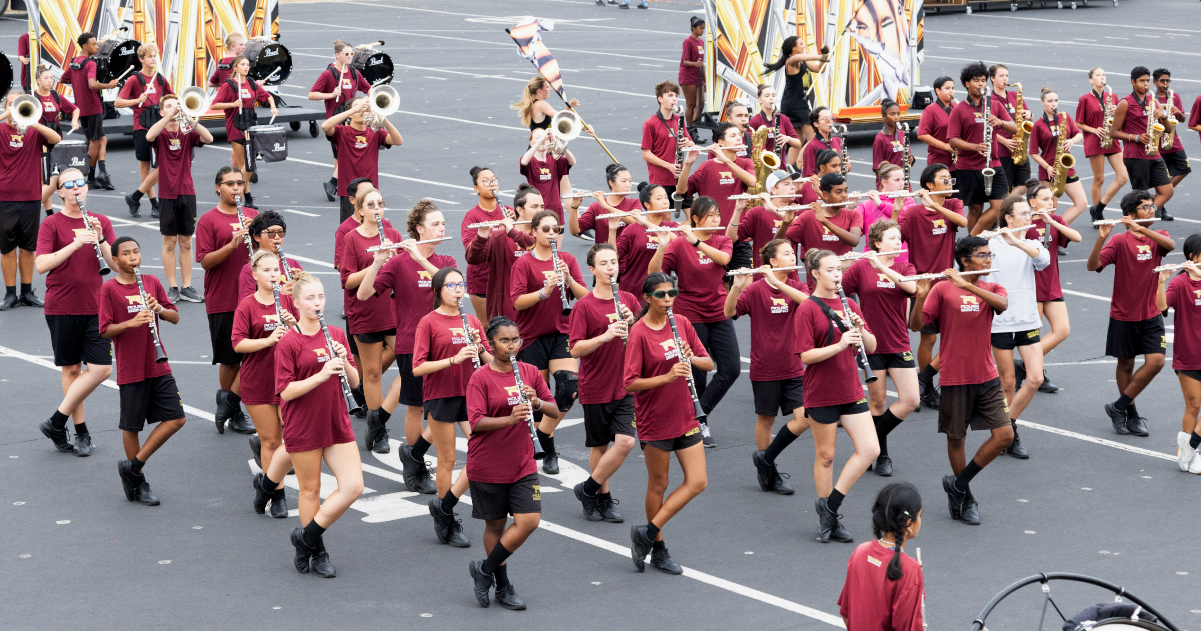
Many band directors know the chaotic energy of a traditional Texas fall. Balancing a competitive state-level marching season with rigorous high school academics is already a monumental task. Now, imagine preparing a monumental 60-minute concert program for the prestigious Midwest Clinic on top of it.
For Director of Bands Ryan Johnstone and Associate Directors Anna Bush and Caitlin Wolfe at Rouse High School in Leander, Texas, this wasn’t a hypothetical situation; it was their reality.
When a premier ensemble faces a packed schedule, the primary threat isn’t a lack of talent; it’s a lack of time. To survive a frantic fall cycle without burning out the staff or the students, the Rouse team didn’t ask for more rehearsal hours. Instead, they decentralized the note-learning process, leaning into MakeMusic Cloud to automate independent home preparation and cultivate a thriving, independent student culture.
The Evolution of a Practice Tool
Rouse’s relationship with music tech has evolved over several years. What started as a basic tool to track individual marching show deadlines has transformed into a fundamental pillar of their school culture.
Today, the software serves as an at-home summer practice partner, allowing students to manipulate tempos and hear professional accompaniments before school even starts. Once the academic year begins, the directors offload stand tunes and dance team music entirely to the platform. By allowing students to master these high-tempo pieces independently at home, the program saves a massive amount of live ensemble time.
![Traditional Note-Learning Bottleneck:
Pass Out Sheet Music → In-Class Sight Reading → Weeks of Learning Parts in Class → Delayed Artistry
Rouse High School Workflow:
Pass Out Sheet Music → Simultaneous Compose Upload → At Home Self-Correction → First Rehearsal: Parts Ready]](http://www.makemusic.com/wp-content/uploads/2026/06/MM-Rouse-Case-Study_In_Blog_Image.png)
The true test of Rouse’s structural workflow arrived via a special commission piece titled Evergreen. The piece was delivered in mid-September, a full month later than originally anticipated.
“Knowing we’d be busy with school and marching band, getting a new piece that late was a little unsettling,” Johnstone admits. “However, we knew we could use MakeMusic to help us learn it.”
Johnstone utilized Compose to upload the new materials directly into the platform as interactive assessment files. He began assigning small, targeted segments to the students. Armed with the immediate “red note/green note” feedback engine, students isolated difficult technical passages, checked their rhythm alignments, and listened to digital reference recordings at home.
The result? At the very first rehearsal, after students had completed their preliminary assignments at home, the ensemble put the piece together for the first time. The run-through was so clean that the directors recorded it and sent it straight to the composer, Viet Cuong, who was enthralled with their execution.
Rewriting the Master Class: The Power of the “Pre-Check”
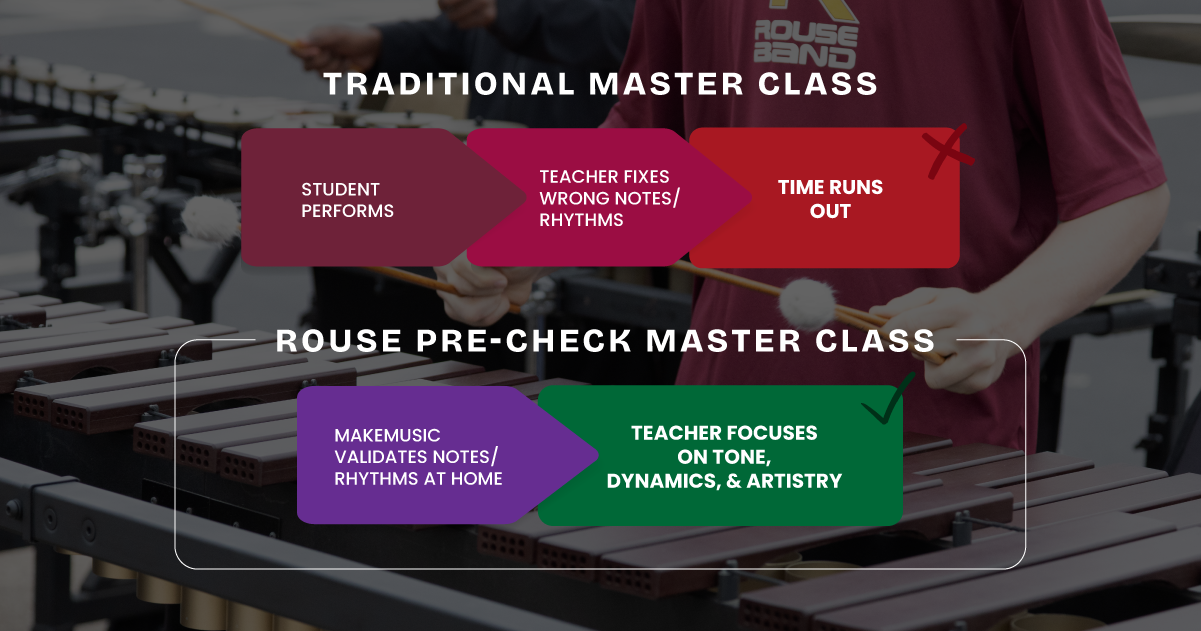
Rouse also leverages the software to maximize the value of their weekly master classes, where students perform individual cuts from their Region music.
Before a student ever stands up to play in front of their peers or a guest clinician, they must achieve a specific target grade on that assigned chunk within the software. This operational gatekeeper changes everything.
“We use it as a ‘pre-check’ to ensure a baseline level of preparation and that students have earned high enough proficiency on notes and rhythms,” Johnstone explains.
By automating the mechanical feedback loop at home, the master class experts don’t have to waste time fixing wrong notes or incorrect rhythms. Instead, they can immediately dive into advanced musicianship, tone quality, dynamics, and the nuances that software can’t grade.
The Pedagogical Recipe: Variable Strictness and Layered Grading
A common trap for directors implementing technology is treating every student and every passage with the same blanket settings. The Rouse associate directors bypass this by treating the software’s technical features like a dynamic dial.
When woodwind players are tackling complex, fast technical passages, Associate Directors Anna Bush and Caitlin Wolfe manipulate the platform’s “strictness” tolerance settings. During the initial learning phase, they leave the strictness low to foster confidence. As the performance cycle progresses, they turn the strictness up. This forces an acute student awareness regarding micro-timing errors and uneven fingerings that a young player might otherwise miss.
Furthermore, they have mastered a tiered grading strategy that targets the whole bell curve of their program:
- For Younger/Non-Varsity Tiers: Directors utilize completion grading (giving an automatic 100 simply for submitting). This serves as a welcoming introduction to the platform, making students feel successful right out of the gate without discouragement.
- For Advanced/Varsity Tiers: They set realistic, stepping-stone thresholds. Assignments might start with an achievable target score of an 80, which is gradually raised to an 85, and eventually a 90 as the ensemble approaches performance day.
From Software Security to Intimate Musicianship
Perhaps the most surprising outcome of Rouse’s complete buy-in is how it has altered the students’ emotional relationship with practicing. In many programs, testing creates intense anxiety. At Rouse, the software has become a source of comfort.
“Our students have actually begun asking for assignments to be put into MakeMusic because it provides them with a sense of security,” say Bush and Wolfe. By catching and correcting mistakes in the privacy of their own homes, the stress of the band room is entirely mitigated. Group rehearsals are no longer a place where students fear playing a wrong note; instead, they are collaborative spaces of mutual trust.
“Sometimes when kids prepare at home, they don’t realize they are making mistakes,” Johnstone notes. “It’s not about the grade, but about the learning and seeing where things aren’t quite lined up. It gives them the information they need to be more productive in their practice.”
When the software handles the administrative weight of note-checking, teachers are liberated to do what they love most: teach artistry. For the Rouse team, the ultimate reward is seeing the level of excellence, trust, and intimate musicianship their students achieve when they step onto the stage.
Reclaim Your Rehearsal Time
Want to replicate Rouse High School’s independent home-learning system and boost student accountability in your own program? Discover how simple it is to leverage variable grading and custom music uploads. Click here to schedule a quick demo with an onboarding specialist.